Business Architecture: The Blueprint That Connects Strategy to Execution
What business architecture is, what it is not, the components and deliverables that make it useful, and how organizations move from a first capability map to an embedded practice
By Capstera Business Architecture Staff · Updated
12 min read
Business architecture is the discipline of describing what an organization does—its capabilities, value streams, information, and organizational structure—independent of how it is currently staffed or automated, so that strategy can be translated into coordinated execution. It gives leaders a shared, stable blueprint for deciding where to invest, what to change, and in what order.
Strategy decks describe intent. Org charts describe reporting lines. Project portfolios describe activity. None of them describes the business itself—the durable set of things the enterprise must be able to do, and how those things combine to deliver value. Business architecture fills that gap. When it works, executives stop debating anecdotes and start pointing at the same map: this capability is weak, this value stream stalls at this handoff, these initiatives are quietly funding the same thing. This guide covers the discipline at survey depth, with links into deeper articles on each component.
Key Takeaways
- Business architecture describes what the business does (capabilities), how it delivers value (value streams), what it must know (information), and how it is organized—separate from processes, systems, and reporting lines.
- It is the business layer of enterprise architecture, distinct from business analysis (project-level requirements) and organization design (reporting structures).
- Its working deliverables are capability maps, assessments and heatmaps, value stream maps, cross-mappings to strategy and systems, and target operating model views.
- Adoption works best starting from a live strategic question and a deliberately shallow first map, then earning its way into planning and funding cycles.
- Most failures are practice failures, not framework failures: mapping for its own sake, over-modeling, IT-only ownership, and artifacts that go stale.
What Is Business Architecture—and What Is It Not?
Business architecture is the discipline that defines and governs the enterprise's business model in terms of its capabilities, value streams, information, and organization—a blueprint of the business that stays stable while projects, systems, and org charts churn.
The discipline is easiest to grasp by contrast. Enterprise architecture spans the whole stack; TOGAF, The Open Group's framework, treats business architecture as one of four architecture domains alongside application, data, and technology. Business architecture is that business layer, practiced in the language of customers, capabilities, and operating models rather than systems and platforms. Business analysis works at project level—eliciting requirements for a specific change—while business architecture works at enterprise level, providing the stable map those projects navigate by. And organization design decides reporting lines, while business architecture describes the work itself: a capability like Claims Management exists regardless of which department currently owns it, and the map should survive the next reorganization untouched. That separation is the point. Because the blueprint is stable and technology-agnostic, leaders can visualize dependencies, spot duplication, and test strategic options without first untangling today's org chart.
- Not an org chart: capabilities describe what the business does, not who reports to whom.
- Not process re-engineering: processes describe how work flows today and change often; the capability view stays stable while the how evolves.
- Not business analysis: requirements serve a single project; business architecture serves the whole portfolio.
- Not an IT modeling exercise: the artifacts describe the business, even when the practice is hosted inside an EA or IT function.
| Business Architecture | Enterprise Architecture | |
|---|---|---|
| Scope | The business layer: capabilities, value streams, information, organization | All layers: business, application, data, and technology |
| Primary question | What does the business do, and where must it change to deliver the strategy? | How should the whole enterprise—business and technology together—fit and evolve? |
| Typical artifacts | Capability maps, value stream maps, capability assessments, target operating model views | Reference architectures, technology roadmaps, standards, cross-domain solution designs |
| Primary audience | Executives, strategy, transformation, and portfolio leaders | CIO/CTO organizations, solution and domain architects |
| Rate of change | Stable maps, refreshed when strategy or the business model shifts | Evolves continuously with technology lifecycles and platform decisions |
Go deeper on definitions and boundaries
- What Is Business Architecture? (Glossary) — The concise definition, origin, and common misconceptions.
- Enterprise Architecture vs. Business Architecture — The full side-by-side comparison of scope, deliverables, and when each leads.
- Business Architecture for Dummies — A plain-language starting point for first contact with the discipline.
What Are the Core Components of Business Architecture?
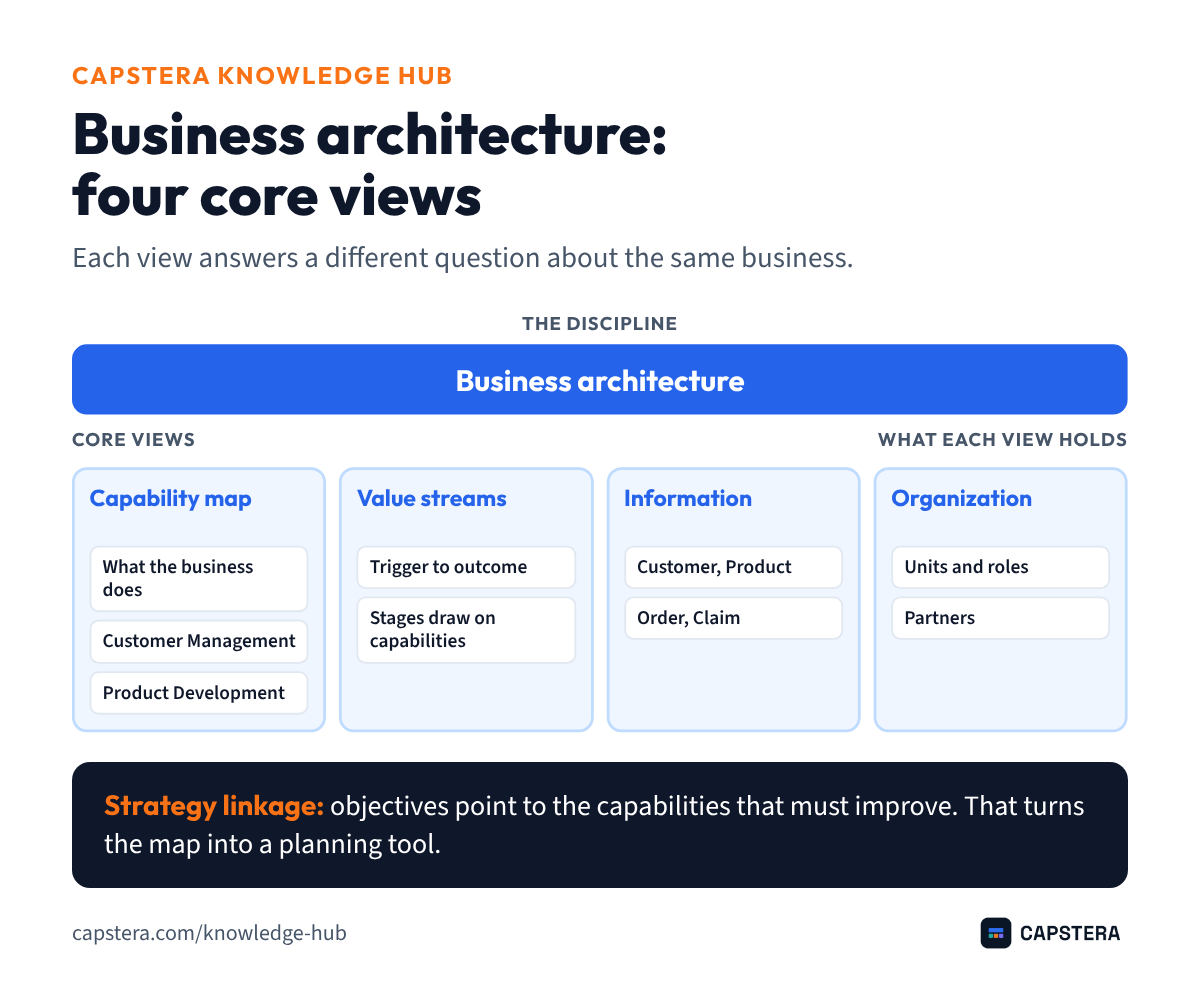
A working business architecture rests on a small set of interlocking views: capabilities, value streams, information, organization, and the explicit linkage of all four back to strategy.
Capability maps are the anchor. They break the business down into discrete, nameable areas of functionality—Customer Management, Product Development, Compliance—expressed as what the business does rather than how or by whom. Unlike process models, which change as operations change, capability maps offer a stable reference framework for long-term planning; layering maturity, performance, and risk assessments onto capabilities yields targeted improvement plans tied to strategic imperatives. Value streams supply the complementary view: they illustrate how value flows through those capabilities from initial demand to realized outcome, exposing bottlenecks, handoffs between units, and the stages where customer value actually gets created—a natural foundation for KPIs and improvement work. Information maps define the business concepts—customer, product, order, claim—that capabilities and value streams must share to interoperate, and organization maps connect capabilities to the units, roles, and partners that perform them, which is where duplication and orphaned work become visible. Together they form a multi-dimensional view: functionality and flow, knowledge and accountability.
- Capability map — the inventory of what the business does, independent of who does it or which system supports it.
- Value streams — end-to-end sequences that deliver value from trigger to outcome, showing which capabilities each stage draws on.
- Information — the business concepts the enterprise must define consistently for capabilities and value streams to connect.
- Organization — the mapping between capabilities and the units, roles, and partners that perform them.
- Strategy linkage — the explicit tie from objectives to the capabilities that must improve; this turns the map from wallpaper into a planning tool.
| Capability Maps | Process Models | |
|---|---|---|
| Focus | What the business does | How the business does it |
| Stability | Stable over time | Often changes frequently |
| Viewpoint | Business functionality | Operational workflows |
| Use Cases | Strategic planning, investment prioritization | Process improvement, automation |
Go deeper on the components
- Business Capability Model Guide — The pillar guide to building, leveling, and using a capability model.
- List of Common Business Capabilities — A reference catalog of capabilities to seed or sanity-check your map.
- Business Architecture Value Streams — Concrete value stream examples and how they differ from processes.
- What Is BIZBOK? — The Business Architecture Guild's body of knowledge, explained.
What Do Business Architects Actually Produce?
The discipline earns credibility through a compact set of deliverables—each one an answer to a question an executive is already asking, not a model produced for its own sake.
The deliverables build on one another. The capability map comes first because everything else hangs off it. Assessments and heatmaps layer judgment onto the map—which capabilities are weak, which matter most to the strategy—and turn a neutral inventory into an argument about where to invest. Value stream maps add the flow view and expose where work stalls between units. Cross-mappings are the connective tissue: capability-to-value-stream shows what value delivery depends on, capability-to-organization exposes duplication, and capability-to-application makes technology investment conversations concrete. Target operating model views and initiative mappings then point the whole apparatus forward: here is the business we intend to be, and here is how the current portfolio does or does not get us there. The test for each artifact is the decision it changed; one that no decision depends on is decoration.
- Capability map — the foundational inventory, kept at a deliberately coarse grain for executive use.
- Capability assessment / heatmap — maturity, performance, and strategic importance layered onto the map.
- Value stream maps — end-to-end value delivery with stages, participating capabilities, and handoffs.
- Cross-mappings — capability-to-value-stream, capability-to-organization, capability-to-application.
- Target operating model views — the future-state picture of how capabilities, organization, and delivery fit together.
- Initiative and investment mappings — which programs touch which capabilities, exposing overlap and orphaned priorities.
- Business architecture diagrams — the communication layer that makes the rest legible to non-architects.
Go deeper on deliverables
- Business Architecture Deliverables — The full survey of artifacts, with what each is for and who consumes it.
- Business Architecture Diagram — Diagram types and examples for communicating the architecture.
How Do Organizations Adopt Business Architecture?
Successful adoption is iterative: secure sponsorship around a real strategic question, build a deliberately shallow first map, prove value on one decision, then integrate with the planning machinery the organization already runs.
Implementation begins with executive sponsorship—not as a formality, but because business architecture only pays off when its artifacts sit inside funding and planning conversations, and only sponsors can put them there. A dedicated team with both business and technology fluency keeps artifacts accurate and actionable. The organizations that get traction start small: pick a high-impact area, build the top levels of a capability map rather than boiling the ocean, and run a pilot that informs a decision someone actually has to make. From there, the practice compounds by integrating with what already exists—enterprise architecture, portfolio management, agile delivery—so the capability lens shows up wherever priorities get set. Governance keeps it alive: standards, named artifact owners, and scheduled refresh cycles prevent the fragmentation and slow decay that kill most mapping efforts. The end state is not a bigger model; it is a planning cadence in which strategy reviews, investment decisions, and transformation programs all reference the same architecture.
Starting a practice?
The Enterprise Business Architecture Starter Package gives a new practice its first deliverables: an enterprise capability map of about 1,975 capabilities across four levels, with definitions and KPIs, enterprise value streams, an operating models overview and a business case template.
From First Capability Map to Embedded Practice
- Sponsor — Secure executive sponsorship around a live question: Anchor the practice to a strategic decision leadership already cares about—an expansion, a cost program, a transformation—rather than selling architecture in the abstract.
- Baseline — Build the first capability map, top levels only: Draft a coarse-grained map with a small team mixing business and technology expertise. Resist detail; depth can come later where decisions demand it.
- Pilot — Apply it to one high-impact decision: Layer an assessment or heatmap onto the pilot scope and use it to inform a real investment or design choice. Credibility comes from a decision changed, not a model completed.
- Integrate — Connect to portfolio, EA, and agile delivery: Feed capability views into portfolio prioritization, link artifacts to the EA repository, and give delivery teams a stable map to plan against.
- Govern — Establish ownership, standards, and refresh cycles: Name owners for each artifact, set quality standards, and schedule updates so models track the business instead of drifting from it.
- Embed — Make it part of the planning cadence: The practice is embedded when strategy reviews and funding cycles reference the map by default—a capability of the enterprise, not a project.
Where Does Business Architecture Go Wrong?
The common failure modes are predictable and mostly self-inflicted: mapping without a decision in view, modeling in too much detail, letting IT own what the business should, and letting artifacts go stale.
The classic failure is the wallpaper map—a beautiful capability model presented once, admired, and never consulted again, because it was built as an end in itself rather than in service of a decision. Its close cousin is over-modeling: teams descend into fine-grained detail before anyone needs it, the effort stalls, and sponsors conclude the discipline is academic. Resistance to change is real but usually a symptom—business leaders disengage when the practice is owned entirely by IT and speaks architecture jargon rather than the language of their P&L. Tool proliferation adds friction: when every group models in its own tool with its own notation, the enterprise ends up with competing maps and no shared blueprint. Stale models are quietly fatal—an artifact that no longer reflects the business actively misleads, which is worse than no artifact at all. And framework wars burn credibility: time spent litigating BIZBOK versus TOGAF is time not spent answering the strategic question that justified the practice. The remedies are the same practices that make adoption work—governance, communication, continuous training, and a relentless tie back to decisions.
Signs Your Practice Is on Track
- Every capability flagged for investment traces to a named strategic objective.
- Artifacts have owners and a refresh cadence, not just a publication date.
- Business leaders—not only architects—reference the map in planning conversations.
- Pilot scope was chosen for a live decision, not for modeling convenience.
- The practice reports outcomes (decisions informed, duplication removed), not model coverage.
- There is one shared map, in one place, rather than competing versions per tool or team.
Who Practices Business Architecture?
Business architects sit between strategy and execution: close enough to leadership to understand intent, close enough to delivery to know what the organization can actually do.
The role is a translator's job. A business architect takes strategic intent and renders it as capabilities to strengthen, value streams to redesign, and investments to sequence—then feeds what delivery teams learn back into the planning picture. The craft rewards an unusual mix: facilitation skills to get competing stakeholders onto one map, disciplined abstraction to keep models at the right altitude, enough domain knowledge to be credible with business leaders, and enough technology literacy to keep capability-to-system mappings honest. Where the role reports varies—some practices sit in a strategy or transformation office, others inside enterprise architecture—but wherever it sits, the practice must stay legible to business leadership or it drifts into the IT-only failure mode described above. For many practitioners it is also a deliberate career move: the role builds the enterprise-wide view and executive exposure that adjacent architecture and analysis roles rarely offer.
Go deeper on the role
- The Business Architect Role — Responsibilities, skills, deliverables, and how the role compares to adjacent architecture and analysis roles.
Frequently Asked Questions
Direct answers to the questions practitioners and searchers ask most about business architecture.
What is business architecture?
Business architecture is the discipline of describing what an organization does—its capabilities, value streams, information, and organizational structure—independent of current processes, systems, or reporting lines. It provides a stable blueprint that connects strategy to execution, so leaders can see where to invest, what to change, and how the pieces of the business fit together.
What is the difference between business architecture and enterprise architecture?
Enterprise architecture spans business, application, data, and technology; business architecture is its business layer, and TOGAF treats it as one of four architecture domains. In practice, business architecture answers what the business does and where it must change, while enterprise architecture also governs how applications, data, and technology evolve to support it.
What does a business architect do?
A business architect builds and maintains the enterprise's capability maps, value streams, and related artifacts, and uses them to inform strategic planning, investment prioritization, and transformation design. The role translates between leadership intent and delivery reality, demanding facilitation skills, disciplined abstraction, and credibility with both business and technology stakeholders.
What are the main business architecture deliverables?
The core set is the capability map, capability assessments or heatmaps, value stream maps, cross-mappings (capability-to-organization, capability-to-value-stream, capability-to-application), target operating model views, and initiative-to-capability mappings. Each should exist to inform a specific decision; artifacts nobody consults are decoration.
Do I need TOGAF or BIZBOK to practice business architecture?
No. BIZBOK, published by the Business Architecture Guild, and TOGAF, published by The Open Group, are useful references for vocabulary and method, but neither is a prerequisite. Successful practices borrow selectively from both and spend their energy on stakeholder engagement and decision relevance rather than framework conformance.
How do you get started with business architecture?
Start with a live strategic question and an executive sponsor who cares about the answer. Build a coarse, top-level capability map with a small cross-functional team, layer a simple assessment onto the area the question concerns, and use it to inform one real decision. Expand depth only as decisions demand, and put governance and refresh cycles in place early.
Pro Tips
- Start with the decision you need to make, not the model you want to build—scope every artifact to a question someone is actually asking.
- Always align capabilities to strategic outcomes; an unlinked capability is inventory, not architecture.
- Use value streams to foster collaboration between business and IT—the flow view surfaces handoffs that capability maps alone hide.
- Regularly update artifacts to reflect evolving conditions; a stale map misleads more than no map at all.