Business Capability Map: Definition, Example and How to Build One
A detailed exploration of business capability mapping to drive alignment, agility, and transformation in your enterprise
By Capstera Business Architecture Staff · Updated
10 min read
A business capability map is a one-page view of everything an organization must be able to do, organized from broad domains into more specific capabilities, independently of the org chart, processes and systems. This article explains what goes on a capability map, walks through a simplified retail example, and covers how to build one and use it for investment decisions.
In today’s rapidly evolving business landscape, organizations must continuously adapt while maintaining strategic clarity. Business capability mapping serves as a foundational practice within business architecture, enabling leaders to understand what their organization does at a fundamental level, independent of organizational structure or technology. This clarity facilitates better decision-making, prioritization, and transformation initiatives.
Key Takeaways
- A business capability map provides a stable, technology-agnostic view of what an organization does.
- It enables strategic alignment by connecting business capabilities to goals, investments, and outcomes.
- Capability maps help identify gaps, redundancies, and transformation priorities effectively.
What Is a Business Capability Map?
Understanding the fundamental concept of business capabilities and their representation is essential before diving into examples.
A business capability is a distinct, cohesive, and measurable ability that a business can perform to achieve a specific outcome. Unlike processes or organizational charts, capabilities focus on the 'what' rather than the 'how' or 'who.' A business capability map visually organizes these capabilities into hierarchical layers, often grouped by domains such as customer management, product development, or operations. This abstraction provides a stable foundation for strategy, design, and transformation, as capabilities remain relatively constant even when processes or technologies evolve.
- Capabilities describe what the business does holistically.
- They are independent of technology and organizational changes.
- They enable cross-functional collaboration by providing a common language.
Components of a Business Capability Map
A well-structured capability map includes various elements that together create a comprehensive view of enterprise abilities.
Typically, a business capability map is organized into multiple layers or tiers. The top layer represents broad capability domains, such as 'Customer Engagement' or 'Supply Chain Management.' These domains further decompose into more specific capabilities — for example, 'Customer Onboarding' or 'Inventory Management.' Each capability is defined with a clear name, description, and sometimes attributes such as maturity level or strategic importance. Capability maps can also be linked to business objectives, value streams, processes, systems, and organizational units to provide traceability and context.
- Tiered organization from broad domains to specific capabilities.
- Clear definitions and descriptions for each capability.
- Linkages to strategic goals and operational elements.
| Business Capability Map | Business Process Map | |
|---|---|---|
| Focus | What the business does (stable capabilities) | How the business does it (detailed process flow) |
| Change Frequency | Low – capabilities change infrequently | High – processes change often with optimization |
| Audience | Executives, strategists, architects | Operations, process owners |
Example Business Capability Map Overview
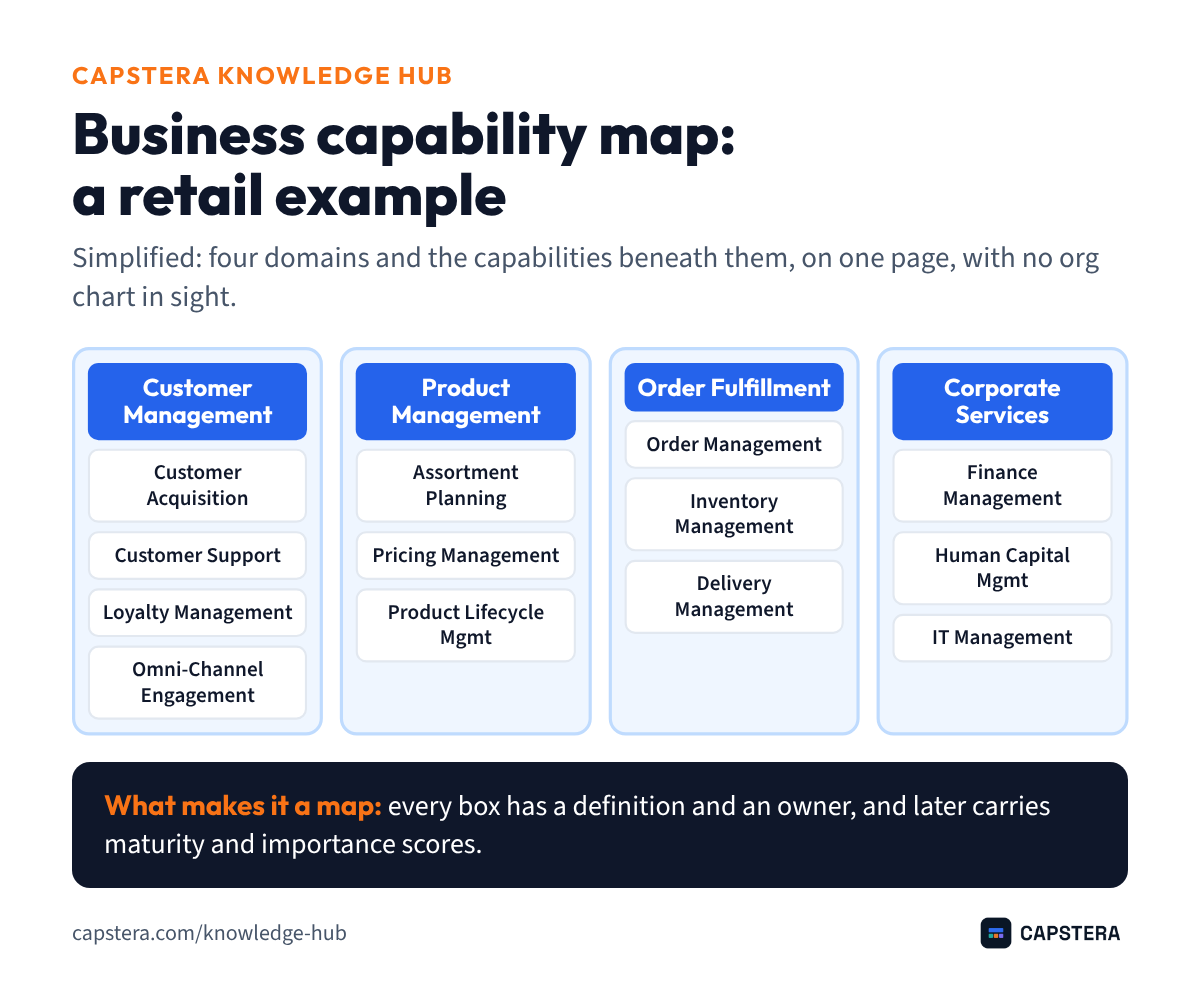
To illustrate, consider a simplified capability map for a retail organization.
At the highest level, capabilities might be grouped into domains such as 'Customer Management,' 'Product Management,' 'Order Fulfillment,' and 'Corporate Services.' Under 'Customer Management,' specific capabilities could include 'Customer Acquisition,' 'Customer Support,' and 'Loyalty Management.' Each capability can be further detailed with sub-capabilities or capabilities supporting digital initiatives, such as 'Omni-Channel Engagement.' This hierarchical structure allows organizations to assess each capability’s maturity, investment needs, and alignment with strategic priorities. The example map serves as a blueprint guiding transformation programs and technology investments.
- Domains organize capabilities into logical groups.
- Each capability is assessed for maturity and strategic relevance.
- Supports prioritization of investments and transformation efforts.
Industry capability maps
The Consumer Retail Business Capabilities Map has about 300 capabilities across three levels, with Level 3 definitions and Level 2 KPIs, in Excel, Word and PowerPoint. The Store has capability maps for 32 industries.
How to Use a Business Capability Map Effectively
Capability maps are powerful when integrated into broader enterprise planning and execution frameworks.
Organizations leverage capability maps to align IT investments with business strategy, identify gaps and redundancies, and drive agile transformation. By mapping capabilities to value streams and business outcomes, leaders can prioritize initiatives that deliver the highest impact. Additionally, capability maps facilitate cross-functional collaboration by creating a shared understanding across business and technology teams. They serve as the foundation for target operating models and guide the evolution of processes, systems, and organizational structures.
- Use capability maps to connect strategy to execution.
- Identify capability gaps to inform transformation roadmaps.
- Engage stakeholders across business and IT for alignment.
Common Challenges and Solutions in Capability Mapping
Despite its benefits, capability mapping can encounter obstacles that reduce its effectiveness.
A frequent challenge is defining capabilities at the right level of granularity – too broad can be vague, too detailed can be overwhelming. Another is securing cross-organizational consensus on capability definitions and boundaries. To overcome these, organizations should leverage established frameworks, engage key stakeholders early, and iterate the map progressively. Leveraging tools that integrate with architecture repositories and strategy platforms can also enhance governance and usability. Finally, embedding capability mapping within a broader business architecture practice ensures sustained value and continuous improvement.
- Balance granularity for clarity and usability.
- Foster collaboration with cross-functional teams.
- Integrate capability mapping into enterprise architecture practices.
Frequently Asked Questions
What is a business capability map?
A business capability map is a structured view of what an organization must be able to do, grouped into domains and broken down into more specific capabilities. It describes abilities, not departments, processes or systems, so it stays stable when those change.
What is the difference between a capability map and a capability model?
The terms are often used interchangeably. Where a distinction is made, the capability model is the full hierarchy with definitions and attributes, and the capability map is the one-page visual view of it, usually showing the top two levels.
How many levels should a business capability map have?
Two or three for most purposes. The top level groups capabilities into domains, the second names the capabilities leaders invest in, and a third is added where a decision, such as application mapping, needs more detail.
What is an enterprise capability map?
A capability map that covers the whole organization across every domain, rather than one business unit or function. It gives every unit one shared list of capabilities to plan, invest and report against.
How do you start building a capability map?
Start from an industry reference model or a common capability list rather than a blank page, adapt the names to your business, define each capability in a sentence, and validate the result in workshops with business owners. Starting from a reference model is considerably faster than building from interviews alone.
Pro Tips
- Start with high-level capabilities and progressively decompose.
- Link capabilities directly to business goals and KPIs for measurable impact.
- Use visual tools to engage stakeholders and communicate value.