Capability Roadmap: What It Is and How to Build One
A capability roadmap puts the capabilities an organization must build or improve into an order it can deliver, and ties every project to a named gap.
By Capstera Business Architecture Staff · Updated
9 min read
A capability roadmap is a time-phased plan that sequences the business capabilities an organization needs to build, improve or retire to reach its target state. Each entry names a capability, its assessed maturity today, the maturity the strategy needs, and the wave in which the gap will be closed. Projects attach to those gaps; the roadmap itself is about abilities, not deliverables. This article covers what goes on a capability roadmap, how it differs from a technology or project roadmap, the steps to build one from a capability assessment, an illustrative example for a retail bank, and the mistakes that turn a roadmap back into a project list.
Most organizations already have roadmaps: product roadmaps, technology roadmaps, program plans. What they often lack is a view that connects all of them to the abilities the strategy depends on. When two programs both claim to improve customer onboarding, or a customer-facing initiative launches before the customer data it relies on exists, the missing piece is usually a capability roadmap.
Key Takeaways
- A capability roadmap sequences capability gaps, not projects. Each entry is a capability with a current and target maturity.
- It is built from a capability assessment: no assessment, no gaps, no roadmap.
- Dependencies decide the order more than importance does. Foundational capabilities come first because later ones cannot work without them.
- Group gaps into waves rather than placing each on a date. Waves survive budget and timing changes; precise dates rarely do.
- Review the roadmap whenever the assessment is refreshed or the strategy changes, and retire entries when their target is reached.
What Is a Capability Roadmap?
A capability roadmap is a sequenced plan for closing the gaps between the capabilities an organization has and the capabilities its strategy requires.
Every entry on the roadmap is a business capability, such as Customer Data Management, Claims Assessment or Demand Planning, described the same way it appears on the capability map. For each one the roadmap records three things: the maturity assessed today, the maturity the strategy needs, and when the gap will be closed. Initiatives, projects and products are attached to those gaps as the means of closing them.
Because capabilities are described independently of departments, processes and systems, the roadmap stays readable when any of those change. A reorganization or a replaced application changes which initiative closes a gap, but not the gap itself.
- Built on a capability map, so every entry uses the same names and definitions as the rest of the architecture.
- Driven by a capability assessment, which supplies the current and target maturity for each capability.
- Ordered by dependency and strategic importance, usually in waves rather than on fixed dates.
- Linked to initiatives, so leaders can see which projects close which gaps, and which gaps have no project at all.
Capability Roadmap vs. Technology and Project Roadmaps
A capability roadmap answers a different question from the roadmaps most organizations already keep.
A technology roadmap tracks the evolution of applications and platforms. A project roadmap tracks the delivery of outputs. A capability roadmap tracks what the organization will be able to do, and how well, at each stage. Technology is one input to a capability; people, process and information are the others. A new platform that nobody is trained to use, or that runs on poor data, does not raise a capability's maturity, and the capability roadmap is where that shows.
| Capability roadmap | Technology roadmap | Project roadmap | |
|---|---|---|---|
| What each entry is | A capability and its maturity gap | An application or platform change | A project or deliverable |
| The question it answers | What will we be able to do, and when? | What will our technology look like, and when? | What will be delivered, and when? |
| What drives the order | Dependencies between capabilities and strategic importance | Technical dependencies, vendor timelines, end of support | Funding, resources and delivery dates |
| What counts as done | The capability reaches its target maturity | The technology is live | The deliverable is accepted |
| What it stays stable through | Reorganizations and system replacements | Organizational change | Little; it changes with each re-plan |
How Do You Build a Capability Roadmap?
The sequence below starts from an assessed capability map. Without the assessment, the roadmap has nothing to sequence.
1. Start from the assessed gaps. Take the capability assessment and list every capability whose current maturity falls short of the target the strategy needs. Leave out capabilities that are weak but unimportant; a heat map that overlays maturity and strategic importance shows which those are.
2. Map the dependencies. For each gap, ask which other capabilities must reach their target first. Customer-facing capabilities almost always depend on data, identity and integration capabilities beneath them. Write the dependencies down; they decide the order more than anything else.
3. Group the gaps into waves. Put foundational capabilities, the ones others depend on, in the first wave. Customer-facing and revenue-generating capabilities usually follow, then advanced capabilities such as analytics and automation that need the earlier waves in place. Three waves is a common shape, not a rule.
4. Order within each wave by strategic importance. Where two gaps have no dependency between them, the one that matters more to the strategy goes first, or gets more of the available capacity.
5. Attach initiatives to gaps. Link each existing or proposed project to the capability gap it closes. Gaps with no initiative need one; initiatives with no gap need a reason to continue.
6. Set the review cadence. Revisit the roadmap when the capability assessment is refreshed, when the strategy changes, or when a wave completes, and retire entries that have reached their target.
From capability model to roadmap
The Business Capability Management Playbook covers capability artifacts, use cases and roadmap guidance, with stakeholder roles, a lightweight governance model and a companion PowerPoint deck. It assumes a capability model is already in place.
Capability Roadmap Example: A Retail Bank
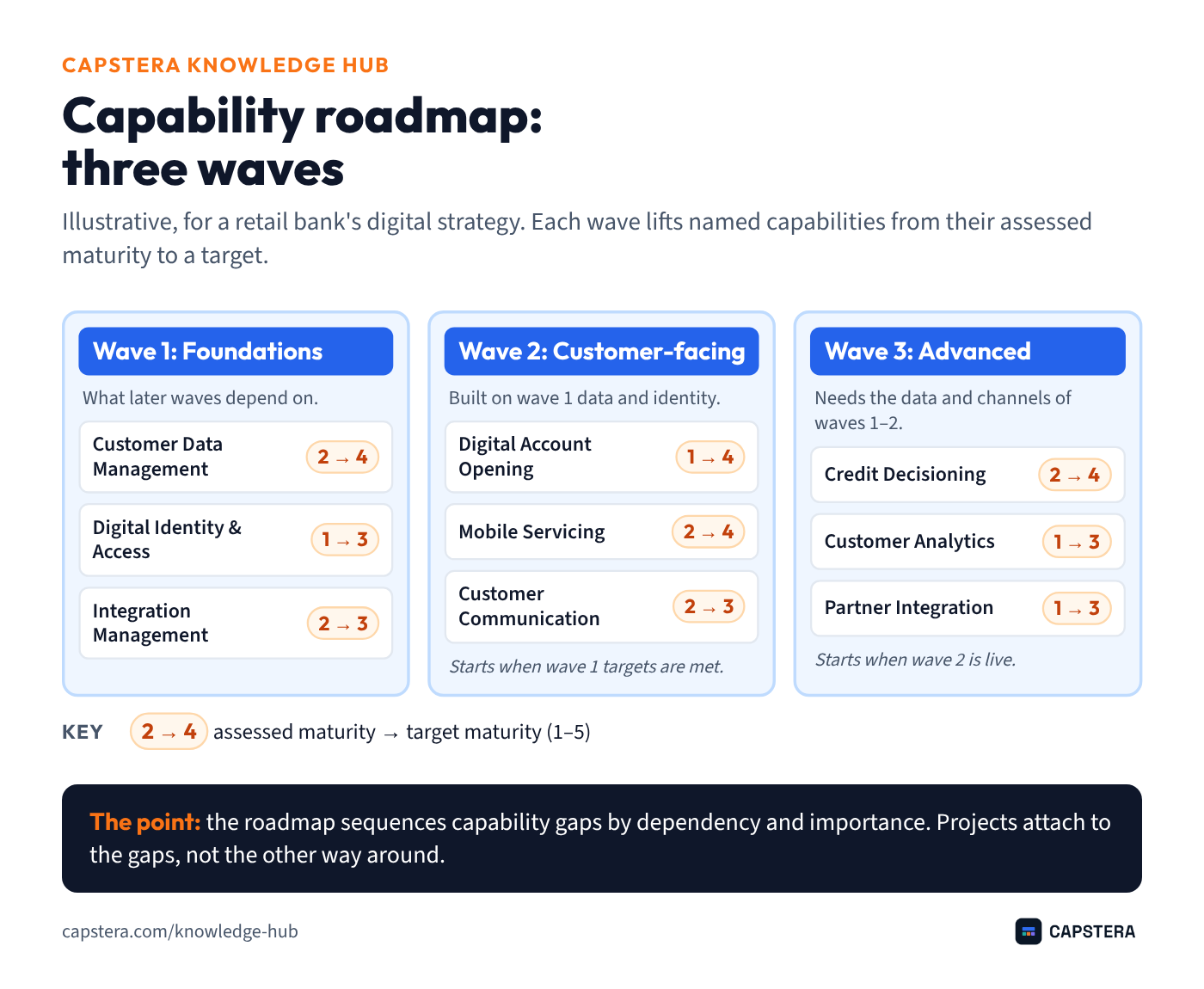
An illustrative example, simplified to nine capabilities, of a bank planning the capabilities behind a digital banking strategy.
The bank's capability assessment shows that its strategy, to let customers open and run accounts entirely on mobile, depends on capabilities it does not yet perform well. The business architecture team lists the gaps, maps their dependencies, and arrives at three waves.
Wave 1 covers the foundations. Customer Data Management, Digital Identity & Access and Integration Management come first, because every customer-facing capability in the plan depends on a single view of the customer, a way to verify who they are, and a way to connect channels to core systems.
Wave 2 covers customer-facing capabilities. Digital Account Opening, Mobile Servicing and Customer Communication start once the wave 1 targets are met. Building them earlier would mean building them on the data and identity problems the bank already has.
Wave 3 covers advanced capabilities. Credit Decisioning, Customer Analytics and Partner Integration need both the data from wave 1 and the digital channels from wave 2 before they can deliver value.
The roadmap then becomes the reference for funding. A proposal to buy an analytics platform during wave 1 is not rejected out of hand, but the roadmap makes the question explicit: which capability gap does it close, and does that capability have what it depends on yet?
Common Mistakes with Capability Roadmaps
Most capability roadmaps that fail turn back into project lists. The causes are predictable.
- Listing projects instead of capabilities. If the entries are project names, it is a project roadmap with a new label, and nobody can see which abilities improve.
- Skipping the assessment. Without current and target maturity, there is no gap to close and no way to tell when an entry is done.
- Ordering by importance alone. The most important capability is often the one that depends on the most foundations. Sequencing it first sets it up to fail.
- Treating technology as the whole capability. A capability reaches its target when people, process, information and technology are all in place, not when the system goes live.
- Building it once. A roadmap that is not revisited when the assessment or the strategy changes stops matching either within a year.
Frequently Asked Questions
What is a capability roadmap?
A capability roadmap is a time-phased plan that sequences the business capabilities an organization needs to build, improve or retire to reach its target state. Each entry names a capability, its current and target maturity, and when the gap will be closed, with projects attached as the means of closing it.
What is the difference between a capability roadmap and a technology roadmap?
A technology roadmap tracks changes to applications and platforms. A capability roadmap tracks what the organization will be able to do and how well. Technology is one input to a capability, along with people, process and information, so a technology change does not by itself close a capability gap.
What do you need before building a capability roadmap?
A capability map with agreed names and definitions, and a capability assessment that gives each capability a current maturity and a target maturity tied to the strategy. The roadmap sequences the gaps between the two.
How do you prioritize capabilities on a roadmap?
By dependency first and strategic importance second. Capabilities that others depend on, such as customer data or identity, go in early waves. Within a wave, the capabilities that matter most to the strategy go first.
How often should a capability roadmap be updated?
Whenever the capability assessment is refreshed, the strategy changes or a wave completes. A common rhythm is a full review alongside annual planning, with lighter checks each quarter.
Is a capability roadmap the same as capability-based planning?
Capability-based planning is the wider approach of planning investment around capabilities rather than projects or organizational units. The capability roadmap is its main output: the sequenced plan that the approach produces.
Pro Tips
- Show the roadmap on the capability map itself, colored by wave. Executives who already know the map read the roadmap in seconds.
- Record the dependency behind every wave boundary. When someone asks to pull a capability forward, the dependency is the answer.
- Keep dates at the wave level. A wave that slips moves as a block; individual capabilities with their own dates drift apart.