Target Architecture
By Capstera Business Architecture Staff · Updated
Target architecture, also called future state architecture, is the documented design of how an organization's capabilities, operating model, information and technology should look at the end of a planning horizon. It is compared with the current state to identify the gaps that transition architectures and a roadmap then close.
Definition
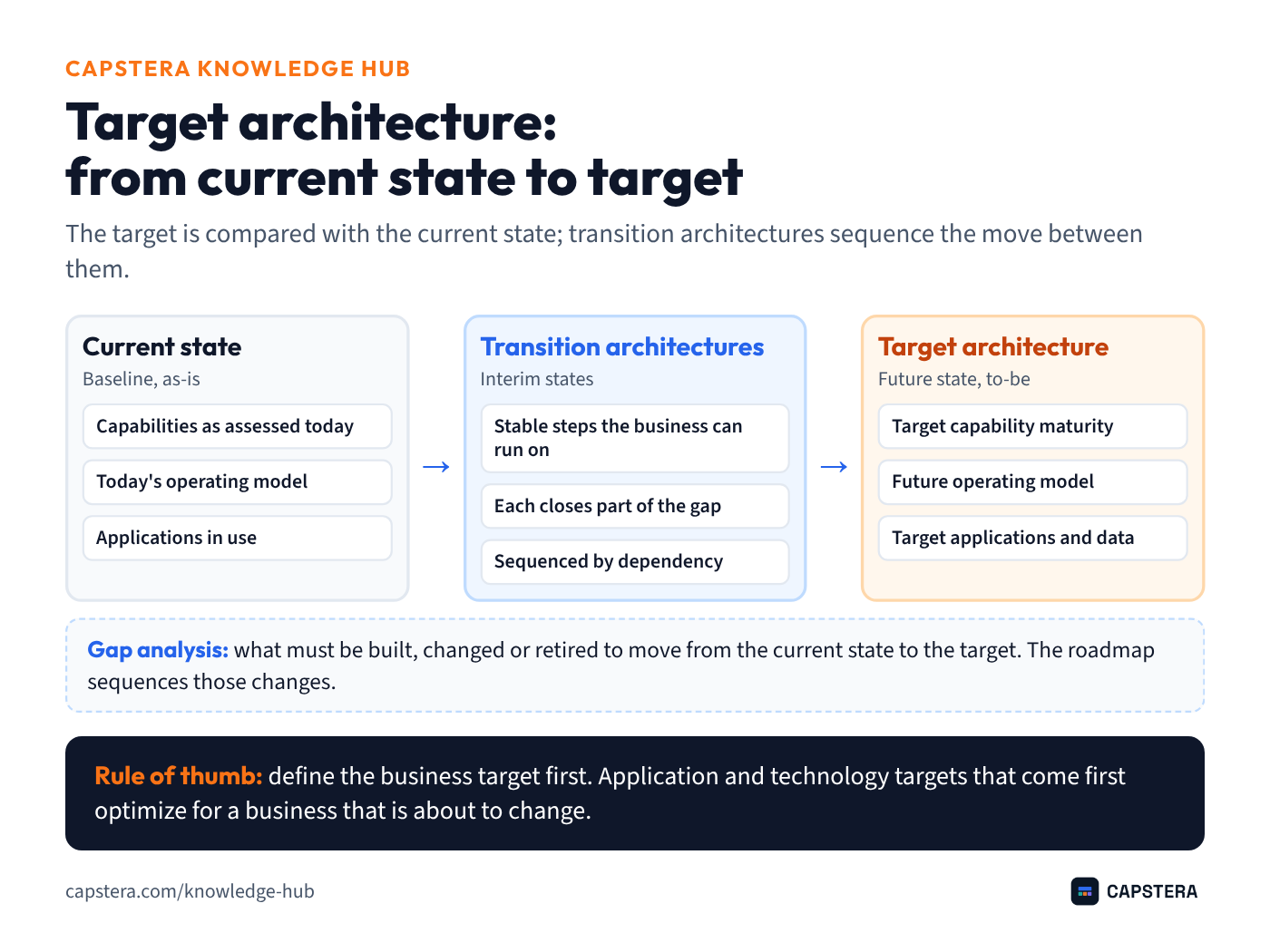
A target architecture is a deliberately designed future state: what the organization's capabilities, value streams, operating model, information and technology should look like once a strategy or transformation has been carried out. It is specific enough to guide investment decisions, sequence initiatives and evaluate trade-offs, which is what separates it from a vision statement. It is a family of views rather than a single diagram. A complete target architecture usually includes a target capability map showing new or improved capabilities, a future operating model showing how work and decision rights will be organized, target value streams, and target application and data architectures mapped back to the capabilities they support. At each layer it states what changes, what is retired and what stays. The target is defined against the current state, also called the baseline or as-is architecture. The difference between the two is the gap analysis, and transition architectures describe the stable intermediate states the organization passes through on the way. Because strategies change, a target architecture is set for a defined planning horizon and revised as conditions change, rather than treated as a final destination.
Origin & Context
Separating as-is analysis from to-be design comes from systems engineering and strategic planning. TOGAF's Architecture Development Method formalizes it for enterprise architecture: Phases B, C and D each describe a baseline and a target architecture for the business, information systems and technology domains, and Phases E and F plan the migration between them. Business architecture practice applies the same current-state and future-state discipline to capabilities, value streams and operating models. "Target architecture", "future state architecture" and "to-be architecture" are used interchangeably.
Why It Matters
CIOs and enterprise architects rely on a well-defined Target Architecture to justify multi-year investment portfolios and avoid funding initiatives that pull the organization in conflicting directions. Business architects use it to trace strategic intent down to specific capability investments, ensuring transformation spend maps to actual business outcomes rather than isolated departmental wish lists. For CFOs and boards, a documented target state provides the traceability needed to defend transformation budgets and demonstrate that spending sequences logically toward a coherent end state. Without it, organizations tend to accumulate a patchwork of point solutions that solve immediate problems while quietly increasing long-term complexity and cost.
Common Misconceptions
- Myth: Target Architecture is the same as a strategic vision or a slide describing where the company wants to be in five years.
- Reality: A vision is aspirational and largely qualitative. A Target Architecture is a structured, multi-domain design — specific capabilities, value streams, data flows, and systems — detailed enough that architects can derive a gap analysis and a concrete transition roadmap from it. If you can't identify what to build or retire from it, it isn't a Target Architecture yet.
- Myth: Once you define the Target Architecture, the job is design-complete and the rest is just execution.
- Reality: Target Architectures are living artifacts. Mergers, regulatory changes, and shifting strategy routinely invalidate parts of the target before it's fully realized. Mature architecture practices govern the target state on a recurring cadence, updating it as conditions change rather than treating it as a one-time deliverable.
- Myth: Target Architecture is primarily an IT/technology artifact.
- Reality: Technology target states are downstream of business target states. Without a defined target operating model, capability map, and value stream design first, the technology target architecture has no grounding — it risks optimizing infrastructure for a business model that's already being reshaped.
Practical Example
A regional insurer launching a digital transformation program tasked its business architecture team with defining a Target Architecture for the claims function. The team started with the current-state capability model, identified redundant claims-intake capabilities across three legacy business lines, and designed a target operating model with a single shared Claims Intake capability supported by a consolidated case management platform. The enterprise architect cross-mapped this business target to the application and data domains, flagging two legacy systems for retirement and one for extension. Portfolio leadership used the resulting gap analysis to sequence a three-phase transition roadmap, prioritizing the capability consolidation before touching underlying systems. The CIO used the documented target state to defend the multi-year budget request to the board, showing each phase's connection to the reduction in duplicated claims-handling effort and improved customer response consistency.
Define the business target
The Enterprise Target Operating Model Toolkit includes current-state assessment templates and target-state visioning templates for more than ten functions: the business side of a target architecture.
Industry Applications
- Financial Services
- Used to design the future-state capability and technology architecture supporting core banking modernization, ensuring compliance capabilities are built in rather than retrofitted.
- Healthcare
- Guides the target state for integrated patient access and care coordination capabilities during EHR consolidation or population health initiatives.
- Insurance
- Defines the future operating model and systems landscape for underwriting and claims following M&A integration, enabling consistent capability delivery across merged entities.
Frequently Asked Questions
What is a target architecture?
A target architecture is the documented future-state design of an organization's capabilities, operating model, information and technology for a defined planning horizon. Comparing it with the current state shows the gaps a transformation has to close.
Is target architecture the same as future state architecture?
Yes. Target architecture, future state architecture and to-be architecture describe the same thing. TOGAF uses "target architecture"; many business architecture practices say "future state".
What is the difference between a target architecture and a target operating model?
A target operating model describes how the business will run: structure, processes, governance, people and locations. A target architecture is broader; it includes the business layer, of which the target operating model is a part, and the information, application and technology layers that support it.
What is the difference between target architecture and transition architecture?
The target architecture is where the organization intends to be at the end of the planning horizon. Transition architectures are the stable intermediate states between the current state and the target, each delivering part of the change.
How do you define a target architecture?
Start from the strategy and the current-state assessment. Define the target capabilities and their required maturity first, then the operating model and value streams, then the information, application and technology architectures that support them. Run a gap analysis against the current state and sequence the changes on a roadmap.
Related Terms
- Gap Analysis: compares the current state with the target architecture to identify what must change
- Transition Architecture: the intermediate states that sequence the move from current state to target
- Architecture Roadmap: sequences the work that moves the organization toward the target
- TOGAF: the framework whose ADM formalizes baseline and target architectures