Value Streams vs. Processes: Stop Conflating Them
They sound interchangeable. They are not — and treating a process as if it were a value stream is how organizations optimize the chopping while dinner arrives cold.
Two words get used as if they were the same thing, and the confusion quietly wastes a lot of improvement money: value stream and process. This issue pulls them apart.
Value Streams vs. Processes: Stop Conflating Them
They sound interchangeable. They are not — and treating a process as if it were a value stream is how organizations optimize the chopping while dinner arrives cold.
Ask ten people in a transformation program to define "value stream" and you will get process maps, journey maps, swimlane diagrams, and at least one org chart. The terms have blurred to the point of being decorative. That would be a harmless vocabulary problem except for one thing: the two ideas point improvement effort in different directions, and confusing them sends real money to the wrong place.
What a value stream actually is
A value stream is the end-to-end flow of value to a stakeholder, described from that stakeholder's point of view. "Acquire a policy," "resolve a claim," "hire an employee" — each begins with a trigger (someone needs something) and ends with value delivered (they have it). It is deliberately indifferent to which departments are involved or how the work is done internally. It describes the journey of the value, not the mechanics of the work.
What a process is
A process is an ordered set of steps that transforms inputs into outputs, usually inside a function and usually owned by one team. "Run a credit check," "issue the policy document," "update the ledger" are processes. They are how the work gets done. A single stage of a value stream is typically delivered by several processes stitched together, often across more than one department.
Why the difference is load-bearing
Here is the trap. Processes have owners; value streams frequently do not. So when an organization sets out to "improve," it improves what has an owner — the processes — because that is where accountability lives. Each team optimizes its own steps. Cycle times drop inside every function. And the end-to-end experience does not get better, because the time and friction were never inside the steps. They were in the handoffs between them — the queues, the rework loops, the waiting — which no single process owner can see and no single process owner is measured on.
This is why a company can run a year of process-improvement projects, hit every local target, and still have customers waiting just as long. The dieting happened where the scale was, not where the weight was. The value stream is the view that exposes the gaps between the steps — and those gaps are usually where most of the delay and cost actually sit.
Use both, in order
The fix is not to pick a side. It is to use them in the right order. Start at the value stream: map the end-to-end flow for a stakeholder, mark where it stalls, and find the worst handoff. Then drop into the processes inside that stage and improve them with intent. Value stream first tells you where to look; process second tells you what to fix. Reverse the order and you get exactly what so many programs deliver — beautifully efficient steps inside a journey that is still slow.
A worked example: the onboarding that wasn't slow
A corporate bank was convinced its client onboarding was slow because its KYC process was slow, so it funded a programme to speed up KYC. Cycle time inside the KYC team duly fell. End-to-end onboarding did not move. When someone finally mapped the value stream — signed contract to first transaction — the delay turned out to live almost entirely in the handoffs: the wait for the relationship manager to gather documents before KYC could start, and the wait for systems provisioning after KYC finished. KYC itself was a small slice of the total. The bank had spent a year making the fastest part faster.
This is the failure in its natural habitat. Every instinct pointed at the process with the obvious name and the available owner. Only the end-to-end view showed that the time was in the gaps between owners, where no process improvement could reach it. Map the stream first and the money goes to the handoff; skip it and the money goes to whichever step is easiest to point at.
And a third term: the journey map
While we are separating words, one more belongs on the list, because it routinely gets folded into both: the customer journey map. A journey map traces the stakeholder's experience — what they see, feel, and struggle with across their interactions. A value stream traces the work that delivers value to them. They are complementary but not interchangeable: the journey map is the outside view of what the customer perceives, the value stream is the inside view of what the organization does to produce it, and processes are the mechanics beneath that. Mistake the journey for the value stream and you optimize sentiment without touching the work; mistake the value stream for the journey and you streamline the work without noticing the customer quietly gave up two steps in. Keep all three on the table and each answers the question only it can.
When the process view is enough
None of this means the value stream is always the right altitude. If a single team owns a self-contained piece of work end to end — a back-office reconciliation, a nightly batch, a contained approval that never leaves one function — then the process view is not a trap; it is the right tool, and reaching for a value-stream map would be ceremony. The distinction earns its keep when work crosses boundaries, because that is the only place handoffs can hide. A useful rule of thumb: if the thing you want to improve lives entirely inside one team's walls, map the process and get on with it. If it crosses two or more teams to reach the person who wanted it, start at the value stream, because the boundaries you are about to optimize across are exactly where its advantage lies. Choosing the right altitude is itself part of the skill — and over-mapping a simple process is its own quiet kind of waste.
Put the two ideas together and you have a simple decision procedure. Name the outcome you care about and the stakeholder who receives it. If reaching that outcome crosses organizational boundaries, you have a value stream, and your first map should be the end-to-end flow that reveals the handoffs. Drop into process detail only inside the stage the value-stream view shows is actually stalling. That sequence — outcome, then stream, then the one process that matters — is how a small team improves something real without boiling the ocean, and it is the entire reason the two words are worth keeping apart.
The architecture connection
There is one more link worth drawing. Each stage of a value stream is enabled by capabilities, and capabilities are what you invest in. So a value stream is not just a lean diagram — it is the bridge from a customer outcome to the capability you should fund to improve it. Map the stream, find the stalling stage, identify the weak capability behind it, and you have turned a vague "we're too slow" into a specific, fundable decision. That is the whole point of keeping the two concepts distinct: each answers a different question, and together they answer the one that matters — where should the next dollar go?
Value Streams Over Processes
Process maps tell you how work flows. Value streams tell you how value flows. These are not the same thing, and confusing them is the most common mistake in business architecture.
A process map answers: what are the steps, and who does them? A value stream answers: where does value get created or destroyed, and where does the customer feel it?
In most enterprises, the process is well-documented and the value stream is invisible. You can show me a 47-step procurement process. You cannot tell me where in that process value is added, where it’s consumed by handoffs, or where the customer experiences the result.
This is why “process optimization” so often produces faster execution of work that didn’t need to happen. You optimized the process. You didn’t shorten the value stream. Start with value. Process is downstream.
Value Stream
A value stream is the end-to-end set of activities that delivers a result to a stakeholder, described from that stakeholder's perspective — for example, "acquire a policy" from a customer's first enquiry to a policy in force. It starts with a trigger and ends with value received.
It is not a process. A process is an ordered set of steps inside a function ("run the credit check"); a value stream usually spans several functions and several processes to deliver one end-to-end outcome. The value stream is the journey; processes are the mechanics of individual legs of it.
Architects use value streams to see across organizational boundaries — where the handoffs, queues, and waiting actually live — and to connect each stage to the capabilities that enable it. That link is what turns a flow diagram into an investment guide: improve the stalling stage by strengthening the capability behind it.
Capstera turns business architecture into a living, governed model — capability maps, value streams, heatmaps, and strategy-to-execution cross-mapping in one place.
Explore the platform →One page, eight questions, no jargon — pin it above the desk of anyone about to “map the process” when they mean the value stream.
Subscribe to get this free download →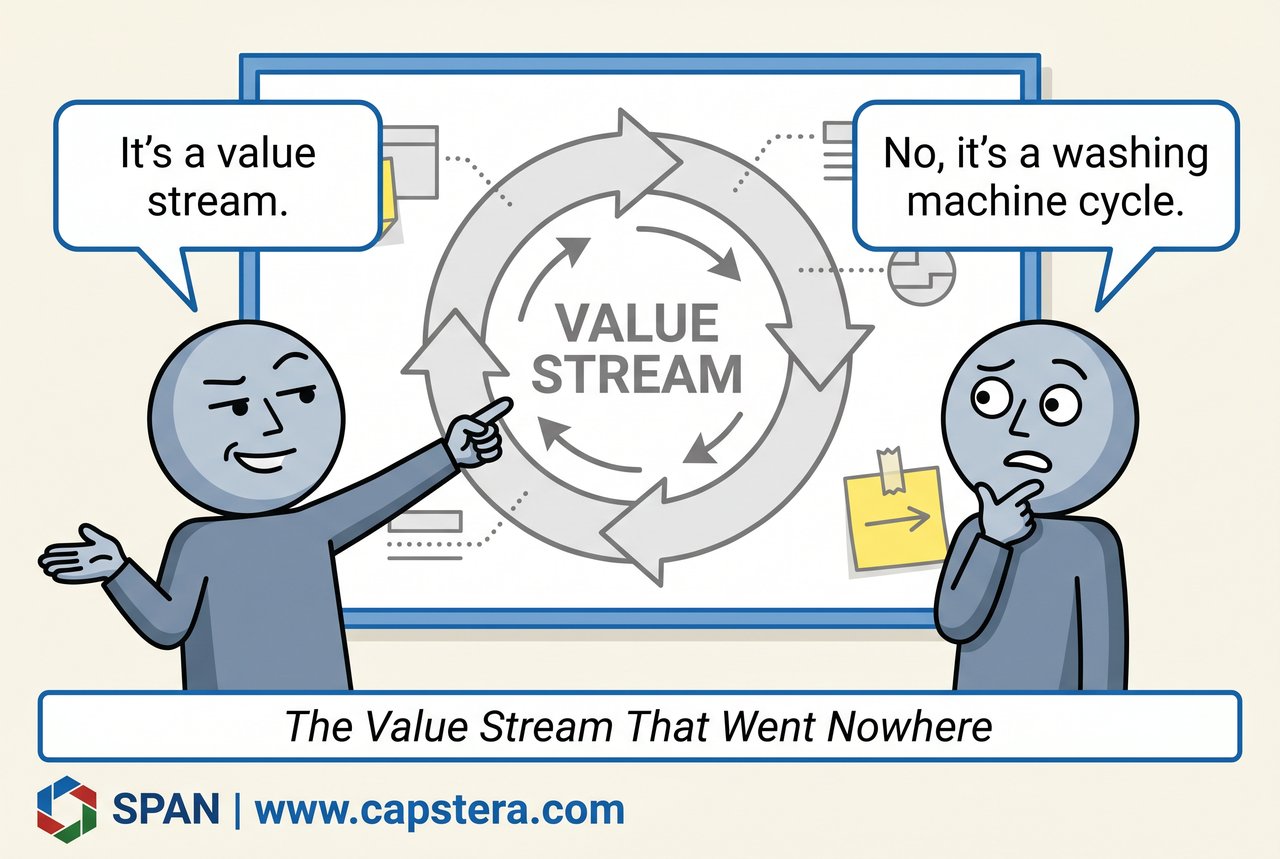
A value stream has 6 stages. Each stage is enabled by exactly 3 capabilities, and each of those capabilities enables exactly 2 of the stages. How many distinct capabilities enable the value stream?
Show the answer
9. Count the stage-to-capability links: 6 stages × 3 = 18. Each capability accounts for 2 of them, so 18 ÷ 2 = 9 distinct capabilities.
An architect, earnest and keen,
Built the cleanest stack ever seen.
But the org chart said “no,”
And rerouted the flow —
Now his diagram’s purely a meme.
Comprehensive Asset Management Business Architecture Reference Model for enterprise architects and strategy consultants to optimize asset capabilities and governance.
View in the store →